Private Car vs Public Transport in North Sumatra for Tourists
Every North Sumatra itinerary eventually runs into this decision: bus and shared transport, or a private car with driver? Budget travelers often default to public transport out of habit, assuming it’s simply the cheaper, more “authentic” option. Sometimes it is. But North Sumatra’s geography — long highland roads, a ferry crossing to reach Samosir Island, and destinations spaced hours apart rather than a short city hop away — changes that calculation more than travelers expect.
This guide compares both options honestly across the factors that actually matter: cost, time, comfort, flexibility, and reliability, using the region’s main routes as real examples.
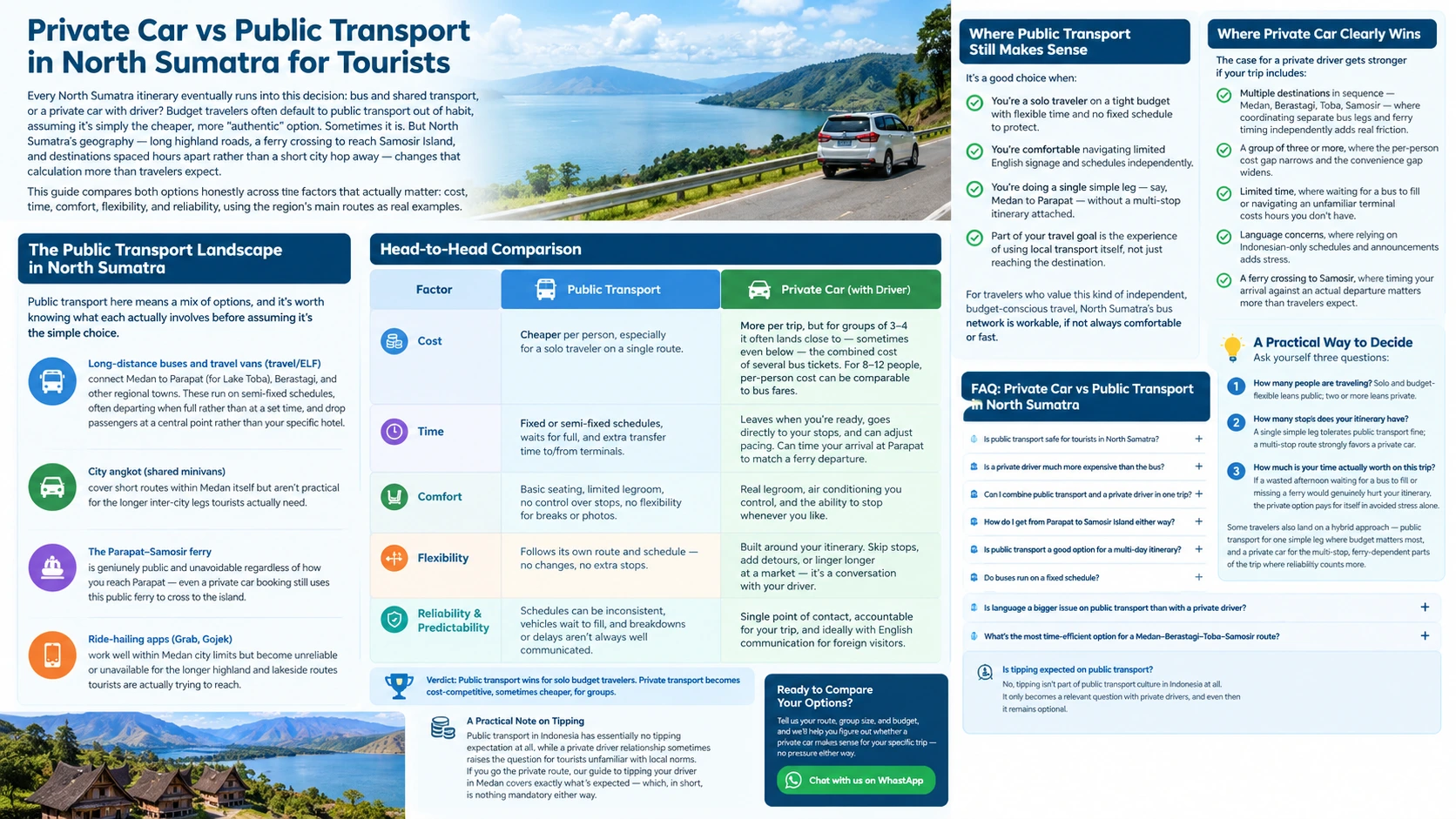
The Public Transport Landscape in North Sumatra
Public transport here means a mix of options, and it’s worth knowing what each actually involves before assuming it’s the simple choice.
Long-distance buses and travel vans (travel/ELF) connect Medan to Parapat (for Lake Toba), Berastagi, and other regional towns. These run on semi-fixed schedules, often departing when full rather than at a set time, and drop passengers at a central point rather than your specific hotel.
City angkot (shared minivans) cover short routes within Medan itself but aren’t practical for the longer inter-city legs tourists actually need.
The Parapat–Samosir ferry is genuinely public and unavoidable regardless of how you reach Parapat — even a private car booking still uses this public ferry to cross to the island.
Ride-hailing apps (Grab, Gojek) work well within Medan city limits but become unreliable or unavailable for the longer highland and lakeside routes tourists are actually trying to reach.
Head-to-Head Comparison
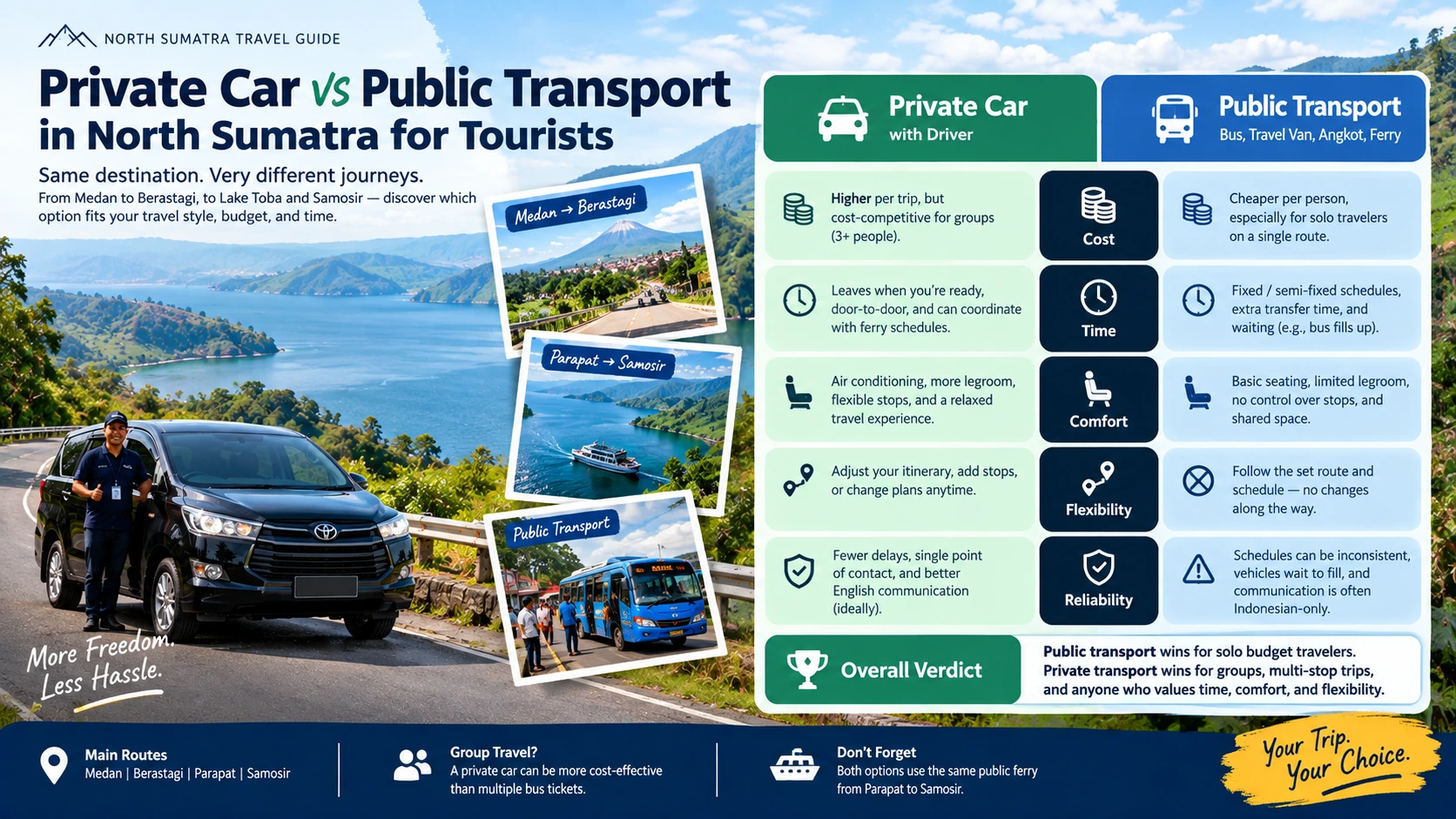
1. Cost
Public buses and travel vans are genuinely cheaper per person, especially for a solo traveler on a single route. A private car costs more per trip, but the math shifts once you factor in a group: split three or four ways, a private car with driver often lands close to — sometimes even below — the combined cost of several individual bus tickets, while adding door-to-door convenience buses can’t match. For a Hiace-sized group of eight to twelve, the per-person cost of a private group vehicle can end up genuinely comparable to bus fares. Our guide to Hiace rental for group tours breaks down that group-cost comparison in more detail.
Verdict: Public transport wins for solo budget travelers. Private transport becomes cost-competitive, sometimes cheaper, for groups.
2. Time
This is where public transport loses the most ground. Buses and travel vans depart on their own schedule — sometimes only leaving once full — and stop at a central terminal rather than your accommodation, adding transfer time on both ends. A private car leaves when you’re ready, goes directly to your specific stops, and can adjust pacing in real time if something takes longer than planned.
On the Medan–Berastagi–Toba corridor specifically, a private driver familiar with the road can also time your arrival at the Parapat harbor to match an actual ferry departure — something a public bus schedule has no way to coordinate with, and a common reason independent travelers end up waiting an hour or more at the dock.
Verdict: Private car wins clearly, especially on multi-stop or ferry-inclusive routes.
3. Comfort
Long-distance buses and travel vans in North Sumatra are functional but basic — shared seating, limited legroom, no control over stops, and a schedule that doesn’t pause for a bathroom break or a photo opportunity. A private car offers real legroom, air conditioning you control, and the ability to stop whenever something catches your eye.
For multi-day routes involving four-plus-hour driving legs, this difference compounds. A cramped shared van for a short city hop is a minor inconvenience; the same discomfort across a long mountain drive to Parapat is a different experience entirely.
Verdict: Private car wins, more decisively the longer the route.
4. Flexibility
This is arguably the biggest practical gap. Public transport follows its own route and schedule — full stop. If you want to add a stop at a viewpoint, linger longer at a market, or change your plan mid-trip, you simply can’t with a scheduled bus.
A private car is built around your itinerary specifically. Want to skip a stop, extend a market visit, or add a detour that wasn’t in the original plan? That’s a conversation with your driver, not a logistical wall.
Verdict: Private car wins outright.
5. Reliability and Predictability
Bus and travel van schedules in North Sumatra can be inconsistent — departure times shift, vehicles wait to fill up, and breakdowns or delays aren’t always communicated clearly to foreign passengers who don’t speak Indonesian. A private booking, by contrast, gives you a single point of contact who’s accountable for your specific trip, and — importantly for foreign visitors — ideally one who communicates clearly in English. Our guide to finding an English-speaking driver in Medan covers why this specific factor matters more here than in more internationally saturated destinations.
Verdict: Private car wins, particularly for travelers without confident Indonesian.
Where Public Transport Still Makes Sense
To be fair to the budget option: public transport isn’t a bad choice in every case. It genuinely makes sense when:
- You’re a solo traveler on a tight budget with flexible time and no fixed schedule to protect
- You’re comfortable navigating limited English signage and schedules independently
- You’re doing a single simple leg — say, Medan to Parapat — without a multi-stop itinerary attached
- Part of your travel goal is the experience of using local transport itself, not just reaching the destination
For travelers who value this kind of independent, budget-conscious travel, North Sumatra’s bus network is workable, if not always comfortable or fast.
Where Private Car Clearly Wins
The case for a private driver gets stronger the more your trip includes:
- Multiple destinations in sequence — Medan, Berastagi, Toba, Samosir — where coordinating separate bus legs and ferry timing independently adds real friction
- A group of three or more, where the per-person cost gap narrows and the convenience gap widens
- Limited time, where waiting for a bus to fill or navigating an unfamiliar terminal costs hours you don’t have
- Language concerns, where relying on Indonesian-only schedules and announcements adds stress
- A ferry crossing to Samosir, where timing your arrival against an actual departure matters more than travelers expect
A Practical Way to Decide
Ask yourself three questions:
- How many people are traveling? Solo and budget-flexible leans public; two or more leans private.
- How many stops does your itinerary have? A single simple leg tolerates public transport fine; a multi-stop route strongly favors a private car.
- How much is your time actually worth on this trip? If a wasted afternoon waiting for a bus to fill or missing a ferry would genuinely hurt your itinerary, the private option pays for itself in avoided stress alone.
Some travelers also land on a hybrid approach — public transport for one simple leg where budget matters most, and a private car for the multi-stop, ferry-dependent parts of the trip where reliability counts more.
A Practical Note on Tipping
One small etiquette difference worth knowing: public transport in Indonesia has essentially no tipping expectation at all, while a private driver relationship sometimes raises the question for tourists unfamiliar with local norms. If you go the private route, our guide to tipping your driver in Medan covers exactly what’s expected — which, in short, is nothing mandatory either way.
Ready to Compare Your Options?
Tell us your route, group size, and budget, and we’ll help you figure out whether a private car makes sense for your specific trip — no pressure either way.
FAQ: Private Car vs Public Transport in North Sumatra
Is public transport safe for tourists in North Sumatra? Generally yes for straightforward routes, though schedules can be inconsistent and English signage limited. It’s a reasonable option for confident, budget-conscious independent travelers.
Is a private driver much more expensive than the bus? Per person, yes for solo travelers. For groups of three or more, the cost gap narrows significantly and can even favor a private car once convenience is factored in.
Can I combine public transport and a private driver in one trip? Yes, some travelers use buses for simple single legs and book a private car specifically for multi-stop or ferry-dependent parts of the route, like Toba to Samosir.
How do I get from Parapat to Samosir Island either way? Both public and private travelers use the same public ferry to cross to Samosir — a private car simply times your arrival at the harbor around an actual departure.
Is public transport a good option for a multi-day itinerary? It’s possible but adds real coordination effort — separate bookings, uncertain schedules, and terminal transfers at each leg. Most multi-day travelers find a private driver considerably less stressful for this reason.
Do buses run on a fixed schedule? Not always. Many North Sumatra travel vans depart once full rather than at a strictly fixed time, which can mean unpredictable waiting.
Is language a bigger issue on public transport than with a private driver? Often yes, since schedules, announcements, and terminal signage are typically Indonesian-only, whereas a private driver can be specifically screened for English comfort beforehand.
What’s the most time-efficient option for a Medan–Berastagi–Toba–Samosir route? A private car, primarily because of ferry timing coordination and door-to-door stops, which public transport can’t match on a multi-destination route.
Is tipping expected on public transport? No, tipping isn’t part of public transport culture in Indonesia at all. It only becomes a relevant question with private drivers, and even then it remains optional.

Maidar Ferianto adalah lulusan Magister Manajemen Pemasaran dari salah satu universitas di Medan dengan latar belakang teknik mesin dan pengalaman nyata di industri CRM, pembiayaan kendaraan, dan logistik. Tulisannya di kamalrentmedan.com lahir dari pemahaman langsung tentang kendaraan dan perilaku pelanggan. Membantu Anda memilih layanan yang benar-benar sesuai kebutuhan, bukan sekadar yang paling murah.